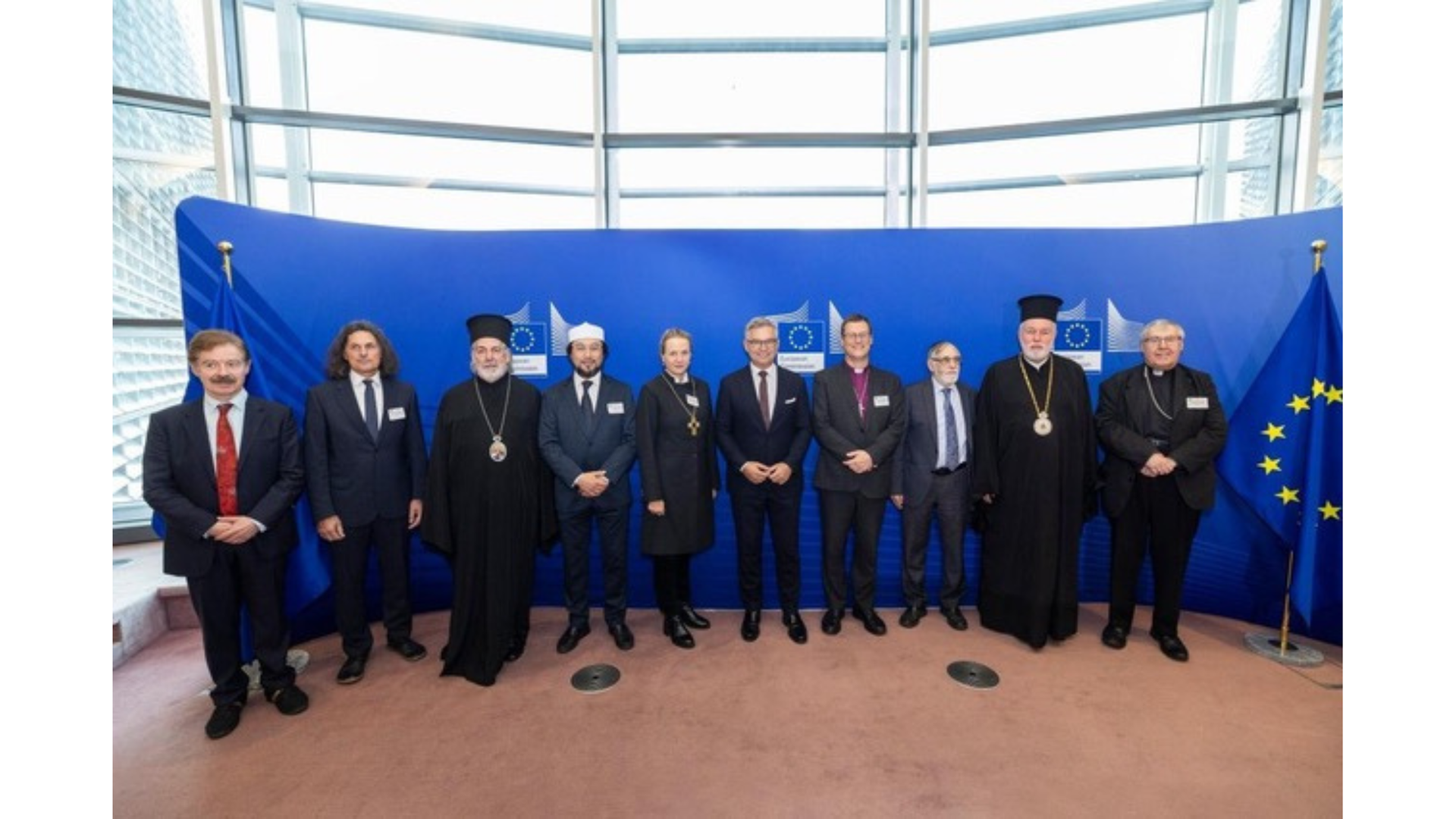
On 17 November 2025, European Commissioner Magnus Brunner chaired a high-level meeting with religious leaders in the framework of Article 17 dialogue with churches, religious associations, philosophical, and non-confessional organizations. Link
EBU President Stefano Davide Bettera was invited to represent Buddhism at this high-level meeting, but because his flight to Brussels had unfortunately been cancelled at the last minute, he asked EBU Vice-President Carlo Luyckx to represent him.
“Thank you, Commissioner Brunner, and thank you to all gathered here today. I speak on behalf of the European Buddhist Union, which is an umbrella organization for 14 National Buddhist Unions and about sixty Buddhist organizations, networks and communities in Europe, representing over six million Buddhists." – Carlo Luyckx
This year’s meeting, which lasted almost three hours, was dedicated to ‘Responding to the polarization of our societies’. The meeting looked at ways to respond to the growing polarization of European societies in the context of the rise in hate speech and disinformation. The meeting addressed the current threats to European democracies, the accelerating role played by the Internet, social media and by artificial intelligence.
The meeting also looked at the role that Churches and religious organizations can play in this respect. Spiritual leaders noted in particular that religion can be misused and manipulated to foster hate and divisions – also noting that in secularized societies, the expression of religious feelings and practice can be excessively constrained. Religious literacy was seen as important to address this situation and, more generally, interfaith dialogue and places to address openly differences, in particular among the youth.
Selected passages from Carlo Luyckx’s speech:
"Buddhism teaches that the roots of conflict are not found only in external conditions, but also in the human mind. Today, public conversation in Europe is marked by tension, fear, and rapid reactivity. Much of this is amplified by new technologies and social media that encourage instant judgement rather than patient understanding.
Across Europe, Buddhists are often a quiet minority, but we feel the consequences of polarization — in the rising hostility towards people of Asian origin, in attacks on places of worship, and in the general hardening of speech. We also observe how conflicts outside Europe spill into our streets and shape our interactions.
In our tradition, we respond to these challenges by strengthening inner resources: compassion, discernment, wisdom and the commitment to non-violence. But we also respond through action — interfaith dialogue, education, support to vulnerable communities, and the cultivation of responsible speech.
A culture can only develop and enrich itself by coming into contact with other cultures. The same counts for religions and philosophies. That is one of the reasons why Article 17 dialogue is so important.
What I carry from the Buddhist tradition into this discussion is a simple idea: peace is both an inner practice and a collective responsibility. Polarization grows when we forget our shared human dignity, and when fear is allowed to speak louder than wisdom.
The Buddha taught that our words create the world we live in. If we choose words that divide, the world becomes divided. If we choose words that recognize our interdependence, the world becomes more open and safe.
As European Buddhists, we stand ready to work with all traditions and institutions to protect the dignity of every person, to reduce hostility, and to cultivate a culture of compassion and mutual respect.”
represent Buddhists on an European level