Click here to register for the AGM 2026
Download here the agenda for the AGM
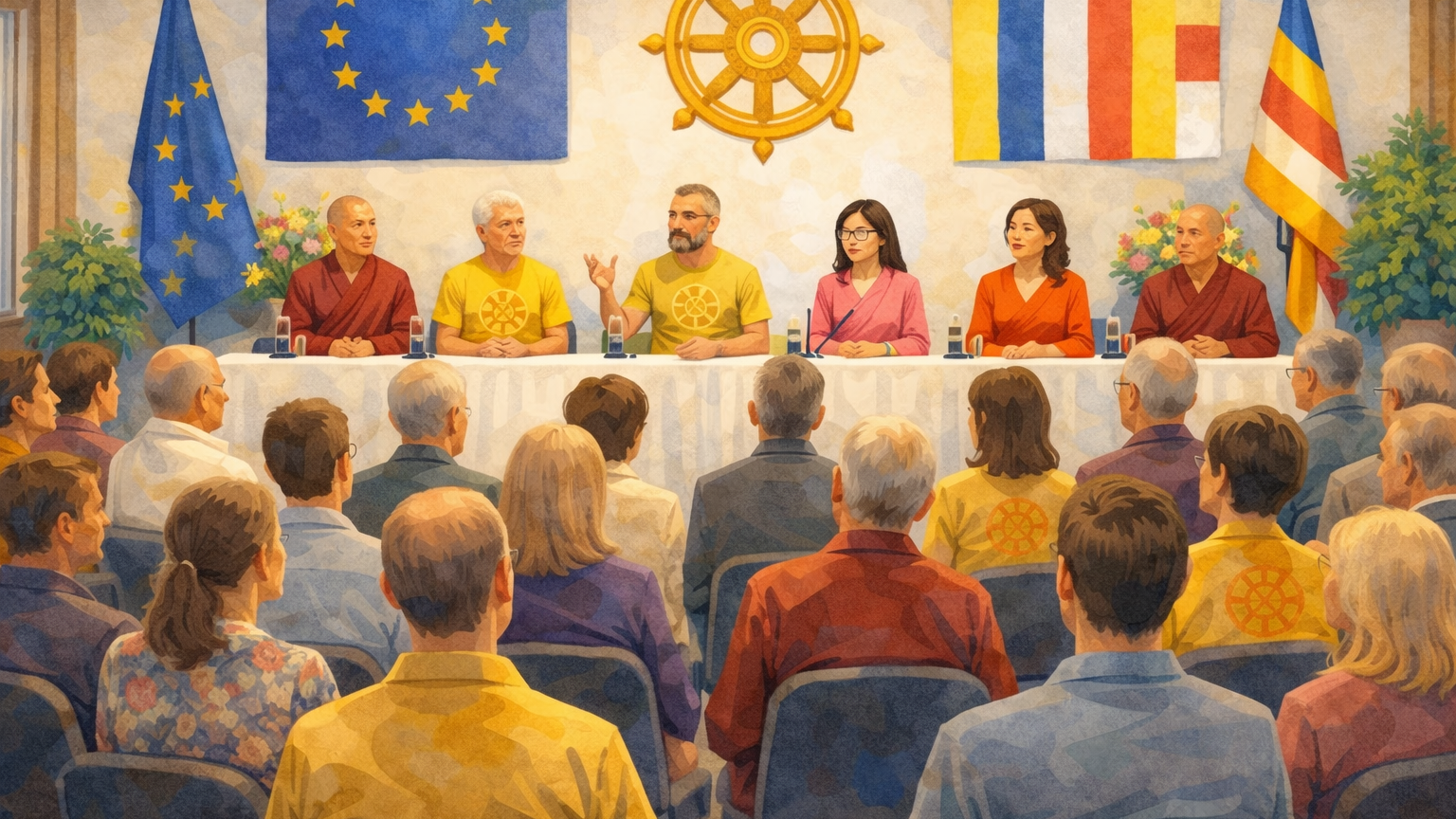
On 9 May 2026, Brussels we will host the annual assembly of the European Buddhist Union, EBU, bringing together representatives of Buddhist communities from across the continent. This year’s theme — “Respect for the Religious Rights of Buddhists in Europe” — is anything but symbolic. It reflects a growing awareness that freedom of belief and religious practice, long regarded as cornerstones of European democracy, can no longer be taken for granted.
Europe finds itself in a period marked by profound strain: armed conflicts at its borders, deepening political polarization within, and the resurgence of nationalist rhetoric and intolerance that challenge cultural and religious pluralism. In such a climate, even communities traditionally perceived as quiet presences in public life — including Buddhist communities — encounter legal, social and cultural obstacles that restrict the full expression of their religious identity.
What Is Buddhism Without Freedom?
The central question guiding this year’s assembly is as simple as it is radical: how can one practice one’s faith when social, political and cultural conditions act as a constraint — or even an outright prohibition? The issue extends beyond the formal guarantees enshrined in European treaties. It concerns the lived reality of faith: the ability to practice openly, to transmit teachings, to organize communities and to be recognized as a legitimate part of Europe’s plural fabric.
A key moment of the day will be devoted to testimonies from delegations representing Ukraine, Poland, Greece and Hungary. In each of these contexts — albeit in different ways — Buddhist communities report challenges ranging from limited legal recognition to cultural environments that are less than receptive to non-traditional religious minorities. Their voices will offer a tangible insight into what it means to practice one’s faith where pluralism feels fragile or under pressure.
Engaging the Institutions
The assembly will not confine itself to testimony. It will also foster dialogue with European institutions and the academic world. Among the most anticipated contributions is that of Professor Marco Ventura of the University of Siena, whose research focuses on religious freedom and the relationship between states, the European Union and faith communities.
His intervention is expected to address what remains incomplete within the European legal and political architecture: uneven legal instruments, inconsistent national applications, and a broader lack of sustained political attention to the needs of minority religious communities. The question is not merely whether rights exist on paper, but whether they are effectively implemented and defended.
Click here to register for the AGM 2026
Download here the agenda for the AGM
A Wider Europe
This gathering will be more than a forum for raising concerns. It is also conceived as a space for collective reflection. Discussions will revolve around essential themes: the meaning of a European Buddhist identity; the practice of faith under conditions of limitation; sustained networking with EU institutions; and the role of the EBU as a bridge between Brussels and local communities, including those geographically distant or numerically small.
Particular emphasis will be placed on dialogue with what might be described as the “wider Europe” — understood less in geographical or political terms than in cultural ones. This includes regions such as Israel and countries bordering the Black Sea, areas with long-standing Buddhist traditions and historical ties that extend beyond today’s political boundaries.
Building the Common Home
Ultimately, what is at stake is not solely the protection of a specific spiritual tradition, but the democratic quality of Europe as a whole. The choice of Brussels as the venue carries clear symbolic and political weight. As the capital of the European Union and the city where many fundamental rights policies take shape, it is also the natural home of the EBU.
To convene here is to bring the voice of Europe’s Buddhist communities into the very heart of the decision-making process — and to reaffirm that religious freedom is not a peripheral concern but a litmus test of democratic health. At a time when the very idea of Europe is contested, the annual assembly of the European Buddhist Union seeks to offer a lucid and necessary moment of reflection: a reminder that without respect for difference — religious, cultural and spiritual — there can be no credible, inclusive and future-oriented European project.
Stefano Davide Bettera
President, European Buddhist Union
represent Buddhists on an European level